
The Content Architecture Problem Killing Your Organic Visibility
Most leasing broker sites don't have a content problem...they have a structural one. Learn how content architecture drives compounding organic traffic.

Most leasing broker websites have a content problem that isn't immediately obvious. It's not that they haven't written enough; many have. It's that what they've written is a bit of a structural mess...from Google's perspective. Whilst pages may exist, they don't relate to each other in a way that signals authority. Content gets published, but it doesn't compound. Traffic arrives at the wrong level of the funnel and leaks away because the supporting pages don't exist to catch it.
Why broker content often fails to compound
Most leasing broker sites do not have a content volume problem. They have a structural problem. Pages exist, but they do not sit inside a hierarchy that signals authority clearly to Google or guides visitors logically toward conversion.
- Architecture matters more than volume because Google ranks connected topic clusters, not isolated pages.
- Most broker sites stop too early at make or model level and miss high-intent variant demand.
- Dynamic filter pages are not enough to create stable, indexable organic visibility.
- Internal links and canonicalisation matter because they shape how authority flows through the site.
- The goal is compounding visibility built on a structure competitors cannot easily replicate.
What this article covers
Jump to the section most relevant to your brokerage.
I know this because I've lived it. Working with a national leasing broker (later acquired by one of the UK's leading car marketplaces), I helped rebuild what was, quite frankly, a very poorly performing custom site into what became a properly structured, product-led platform with search and conversion at its core. We took organic traffic from zero to over 70,000 organic users in a single month; even more with paid traffic in the mix.
That result wasn't driven by content volume alone (although we produced plenty). It was driven by content architecture: a deliberate, hierarchical structure that told Google exactly what the site was authoritative about, at every level of the product range.
This article is about how that structure works, where most broker sites fall short of it, and what the highest-leverage moves look like for a brokerage trying to build organic visibility that compounds rather than stagnates.
Why Content Architecture Matters More Than Content Volume
Google's understanding of your website isn't just about individual pages. It's about the relationship between pages; what links to what, how topics connect, which pages exist at which level of specificity, and what the internal signal structure tells it about your expertise in a given area.
A leasing brokerage that has a BMW page, a few scattered model pages, and a handful of blog posts about EVs doesn't read to Google as a BMW authority. It reads as a site with BMW content. The distinction matters enormously in how it ranks.
The brokerages winning significant organic traffic in leasing have understood something the others haven't: authority is architectural. You build it by creating a coherent hierarchy, from broad category down to specific make, model, and variant, and by connecting those pages with internal links that reinforce the structure. It isn't enough to have a page for the BMW 3 Series. You need that page to live inside a BMW hub that lives inside a car leasing hub, and every level of that structure needs to talk to every other level intelligently.
When that architecture exists, Google can understand your site the way an expert reader would. When it doesn't, even well-written individual pages struggle to rank because the context around them is absent.
The same structural problem appears across other acquisition channels too. Social media, for example, often drives traffic to generic offer pages that lack the supporting content needed to convert that interest into enquiries. Our guide to social media marketing for leasing brokers explores how those channels work when connected properly to the rest of the broker's growth infrastructure.
Where Leasing Sites Are Most Commonly Mis-Structured
Before talking about what good architecture looks like, it's worth being specific about where broker sites typically go wrong. Because it isn't random. The structural gaps cluster around predictable patterns, and understanding them is the fastest way to identify where your own site is leaking visibility.
BMW: strong brand presence, weak depth. Most brokers have a /bmw-lease-deals/ page. Very few have /bmw-3-series-lease/, /bmw-3-series-touring-lease/, /bmw-3-series-330e-lease/, or /bmw-3-series-m-sport-lease/. Variant-level intent is real and measurable. Searches like "BMW 330e lease" and "BMW X1 M Sport lease" carry clear transactional intent, but most broker sites rely on dynamic filters to surface these results; meaning no static indexable URLs, no structured content, no internal linking logic. Google sees a grid of offers, not a hierarchy of expertise.
Audi: model versus body type confusion. Audi is particularly poorly structured across the broker market because the product range demands body-type differentiation that most sites don't provide. Someone searching "Audi A4 Avant lease" is not looking for "Audi A4 lease deals (all variants)." They have a specific body type in mind. Many brokers combine these into one page, split them inconsistently, or rely entirely on filters. Google rewards specificity; most Audi content on broker sites doesn't provide it.
Tesla: trim and use-case content almost entirely absent. Tesla's smaller model range creates a false sense that less content is needed. In practice, search intent separates meaningfully across Model 3 Long Range lease, Model 3 Performance lease, and Model Y business lease. Given Tesla's strong fleet and salary sacrifice appeal, the absence of use-case-specific content (business leasing, tax positioning, charging cost framing) is a structural gap with real commercial consequences.
Volkswagen: powertrain differentiation ignored. Hybrid and PHEV search demand is increasingly separated from general EV demand. Searches around the Golf eHybrid, Passat GTE, and the ID range differentiate by powertrain in a way that most broker content doesn't reflect. Lumping everything under "Golf lease deals" misses a growing segment of intent that is lower competition than core EV terms and easier to rank for.
Emerging EV models: structurally underdeveloped despite growing demand. Models like the Kia EV6, Hyundai IONIQ 5, and Polestar 2 often have strong search growth, lower competition than legacy brands, and shallow content across the broker market. Because brokers prioritise volume brands, these models are frequently treated as catalogue entries rather than content opportunities. That gap is currently exploitable, and the brokers leaning into it are building early positions that will be difficult to displace.
The single most common mistake underneath all of these is the same: over-reliance on dynamic filter pages. A URL structure like /lease-deals?make=bmw&model=3-series may work for the user, but from a search perspective it's structurally weak. URL parameters are unstable, content is thin, internal linking architecture is absent, and there's no semantic reinforcement of the page's topical relevance. Google wants stable, structured, hierarchically organised content. Dynamic filters, however sophisticated the platform, don't provide that.
The Three-Level Hierarchy Every Leasing Broker Needs
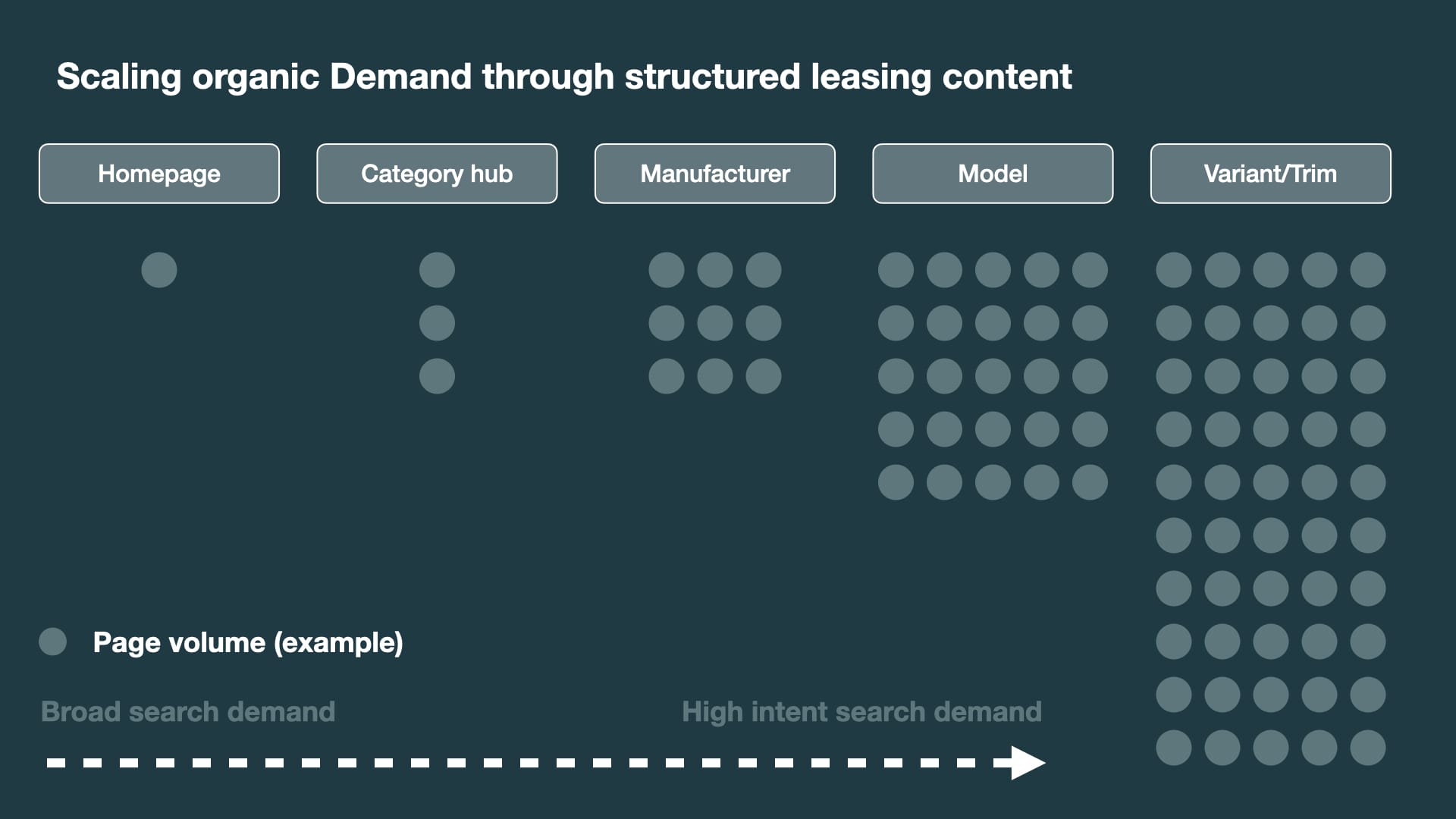
The most effective content structure for a leasing broker operates across three distinct levels, each with a different job to do.
Level one: the category or make level
These are your broadest pages: SUV leasing, electric car leasing, BMW leasing, Mercedes leasing. Their job isn't to convert immediately. Their job is to capture high-intent search terms and funnel visitors downward into more specific content. They should answer broad questions, establish your credibility in that category, and link authoritatively to every make and model page beneath them.
Level two: the make/model level
BMW 3 Series leasing. Audi Q5 leasing. Tesla Model Y leasing. In well-structured broker sites, the majority of organic traffic enters at this level, because leasing customers typically arrive with a clear sense of what they want: by vehicle type, brand, or budget. This makes make/model pages the most important bottom-of-funnel content on the site. They should cover the vehicle properly, address the typical lease questions around that model (residual values, trim considerations, deal structures), and link both upward to the make hub and laterally to related models.
Level three: variant or configuration-level content
BMW 3 Series Sport leasing. Audi Q5 45 TFSI leasing. Volkswagen Golf eHybrid leasing. This level is where most brokers stop one layer too early, and it's where the most underserved search demand currently sits. Someone searching for a specific trim variant on a specific model is typically close to a decision. The commercial intent is high, the competition is often lower than at the model level, and a structured page that directly answers that intent will outperform a filtered results grid almost every time.
The hierarchy isn't just an organisational principle. It's a signal architecture. When these three levels are properly built and connected, the internal link structure tells Google that you have depth of knowledge across the category; not just one good page, but an entire expertise ecosystem. That's what builds ranking authority that's hard to displace.
Want to understand where your broker site is structurally leaking visibility?
Willowford Creative reviews broker website structure through the lens of search architecture, internal linking, indexation and model-level opportunity, so you can see what is holding organic growth back and what to fix first.
Let's talkThe Cannibalisation Problem Nobody Talks About
There's a structural mistake that deserves its own section, because it's counterintuitive and I've seen it quietly undermine sites that have otherwise done the content work correctly.
If you build Make > Model > Variant pages and index all of them, the variant pages will often compete against the model page for the same search terms. Google has to choose which page to rank, and when it's splitting its assessment across multiple similar pages, none of them rank as well as they should. The result is slower progress across the entire cluster, even though more content exists.
The fix is disciplined canonicalisation. Variant-level pages that are structurally important for internal linking and user navigation don't always need to be indexed. In many cases, canonicalising variants back to the model page concentrates the ranking signal where it will do the most work, while still allowing the variant content to exist and serve users who navigate to it. This is a nuanced call that depends on the search volume and competitive landscape at the variant level, but the principle is consistent: indexing everything isn't always better than indexing strategically.
Finding the Keyword Difficulty Sweet Spot
One of the most practically useful things I learned building organic traffic in this market is that brand size and content priority shouldn't always align. The instinct is to go hardest on the biggest brands: BMW, Audi, Mercedes; because the volume is there. But so is the competition, and in a market where well-funded comparison sites and large broker groups are also targeting those terms, a smaller brokerage fighting for "BMW 3 Series lease" from a standing start is choosing a hard fight.
The smarter approach is to find the keyword difficulty sweet spot: models with meaningful search demand but lower competitive density, where well-structured content can achieve ranking positions faster and with less authority behind it. The Volkswagen e-Up was a good example of this in practice. At a time when "Tesla Model 3 lease" was a fiercely contested term, the e-Up had real search intent, limited structured content across the broker market, and a competitive window that rewarded early movers. We found meaningful traction there that would have taken significantly longer against the headline EV terms.
The same logic applies today to emerging EV models, specific PHEV variants, and use-case combinations like "business lease" or "salary sacrifice" appended to model terms. The volume is lower but the intent is higher, the competition is thinner, and the compounding effect of ranking early in a growing category is considerable.
Realistically, expect three to six months to see meaningful progress from well-structured content at the model level, assuming consistent execution and a keyword difficulty sweet spot that's been chosen thoughtfully. Progress isn't just a function of what you build; it's also a function of what competitors are doing. A well-structured model page with competitive pricing will rank. A well-structured page where a competitor has noticeably better deals will struggle regardless of the content quality. Both dimensions matter.
Internal Links: The Part Most Brokers Get Wrong
Internal linking in most broker websites is either absent or random. Pages exist in isolation, or link haphazardly to the homepage and nowhere else. This wastes an enormous amount of structural value that's already on the site.
The way to think about internal links is as votes of relevance. When your BMW 3 Series page links to your BMW 5 Series page, and both link up to your BMW leasing hub, and that hub links down to each of them in turn; you're creating a mesh of relevance signals that Google reads as a coherent body of topical authority. When those links are absent, each page is operating alone.
A useful reference point here is Carwow. Their reviews section demonstrates this kind of content pillar architecture clearly: a hub page for small cars that internally links to every relevant model review, which itself appears in topic-led listicles like "most economical cars." Each piece of content feeds the others, and the internal linking structure reinforces topical authority at every level. It's the same principle applied to a different content type, and it's worth studying if you want to understand what well-executed content architecture looks like at scale.
Practically, this means every model page should link to its make hub. Every make hub should link to the category level. Related models should link laterally to each other; the 3 Series page should reference the 5 Series for customers considering a step up, and vice versa. Comparison pages like "BMW 3 Series vs Mercedes C-Class leasing" can do extraordinary internal linking work because they naturally reference two model pages and often rank for high-intent comparison queries that individual model pages can't capture on their own.
Anchor text matters too. "Click here" is wasted. "BMW 3 Series leasing deals" as anchor text passes meaningful context to Google about what the destination page is about. A small discipline that compounds significantly across a site with hundreds of model pages.
Although it's important, internal linking is only one part of the wider infrastructure behind a broker website. The underlying platforms, CRM systems and quoting tools also shape how effectively traffic converts once it arrives. Our breakdown of the leasing broker technology stack looks at how those layers fit together across a modern brokerage.
Updated Content: The Signal Most Brokers Ignore
Leasing is a market where prices, availability, and deals change constantly. A model page created three years ago with static content and outdated pricing sends a quiet signal to Google that this is a low-maintenance, low-priority page. That signal accumulates and depresses rankings over time, often in ways that are invisible until the traffic graph tells the story.
Regularly updated content sends a different signal. When Google crawls your BMW 3 Series page and finds that the last modified date is recent, that the pricing section reflects current market rates, and that the copy addresses the current lease landscape for that vehicle... it reads that page as live and current. Freshness is a ranking factor, particularly in commercial categories where the information ages quickly.
The practical implication is that model pages shouldn't be treated as set-and-forget assets. The brokerages with the most stable organic traffic treat their highest-priority model pages as living documents; reviewed quarterly, updated when deals shift, expanded when new trim levels launch or when common customer questions evolve. It's not glamorous work. But it's the work that defends rankings once they're established.
There's a second reason freshness matters beyond the ranking signal. A customer who lands on a leasing page that references pricing from eighteen months ago doesn't trust it. They leave. The dwell time drops, the bounce rate rises, and the behavioural signal compounds the original freshness problem. Updated content isn't just an SEO discipline; it's a conversion discipline too.
Page Performance: The Technical Floor Everything Else Rests On
None of the above architectural work delivers its full value if the pages themselves perform poorly. Core Web Vitals (Google's framework for measuring page experience) have been a confirmed ranking signal since 2021, and their importance has only grown as the algorithm has become more sophisticated in how it measures and weights them.
For leasing broker sites specifically, the most common performance problems cluster around predictable issues. Image-heavy vehicle pages that load slowly on mobile. Uncompressed hero images that delay the largest contentful paint. Third-party scripts (comparison widgets, chat tools, aggregator embeds) that block rendering and inflate total blocking time. And sites built on platforms that haven't been properly optimised, where the underlying code is doing unnecessary work before a page becomes interactive.
The floor here isn't perfection. But it is competence. A leasing model page that scores in the red across Core Web Vitals is fighting the algorithm while trying to rank; burning structural and content equity just to compensate for a technical handicap that doesn't need to exist. A page that passes, particularly on mobile where the majority of leasing research now happens, starts the ranking conversation from a neutral position rather than a deficit.
One thing worth checking: page speed at the model level specifically, not just the homepage. Homepages are often well-optimised because they're the most visible. Model pages, which are frequently templated and image-heavy, are where performance problems tend to hide
The Make Hub: Why It's Worth More Than It Looks
The make-level hub page is often underestimated by brokers focused on ranking model pages. But the hub is structurally important in a way that model pages can't replicate.
A well-built BMW leasing hub tells Google three things simultaneously. That this site has breadth across the BMW range; not just one or two models, but the full picture. That the site is organised around topic clusters in a way that signals genuine expertise rather than opportunistic content. And it creates a single high-authority page that can rank for competitive make-level searches ("BMW leasing") while distributing link equity downward to every model page beneath it.
The mistake is building make hub pages as thin navigation pages: a heading, a brief paragraph, and a grid of model thumbnails. That's a directory, not a hub. A proper hub page covers the make in substance: why people lease BMWs, how BMW residual values compare, what the key differences between core models are, what a prospective BMW leasing customer typically needs to know at the research stage. It earns its ranking by being genuinely useful at the make level, not just by pointing to model pages.
When the hub is properly built, the whole cluster rises. Model pages benefit from the link equity flowing from the hub. The hub benefits from the internal links flowing up from model pages. Google's understanding of the site's authority in that make deepens at every level of the hierarchy.
How to Audit Your Own Structure
The five checks I would run on a broker site first
Most structural problems become obvious quickly when the site is reviewed through the lens of hierarchy, indexation and internal links.
If you want a practical read on where your site currently stands, this is the process I'd use.
Start by listing every make you operate across. For each one, ask whether you have a substantive hub page or a navigation page. Then go one level down: for every significant model in that make, ask whether you have a dedicated page with real content or whether that model only appears in a filtered results grid. For your highest-volume models, go one level further: do you have variant-level pages for the configurations with the clearest transactional intent?
Then look at how those pages connect. Pull up your model pages and check how many of them link upward to their make hub. Check whether your make hubs link downward to every model. Look at whether related models cross-reference each other. If the pages exist but the links don't, you have a structural asset that isn't compounding the way it should.
Finally, check your indexation. If you have variant-level pages, are they indexed? If they are, are they competing with your model pages for the same terms? Running a site search for a specific model and looking at how many pages surface for the same query will tell you quickly whether cannibalisation is a problem.
None of this requires specialist tools to get started. It requires honest assessment and a willingness to look at the structure as Google sees it, rather than as your CMS organises it.
What a Properly Structured Broker Site Looks Like in Practice
To make this concrete: a well-architected leasing broker site has a top-level "car leasing" hub that connects to make-level hubs for every significant brand in the range. Each make hub connects downward to model pages for every vehicle in that brand's lineup the broker operates across. Each model page connects to canonicalised variant-level pages for the highest-commercial-intent configurations. Comparison pages sit alongside model pages and cross-link between them.
Every page links upward. Every hub links downward. Related content links laterally. The whole structure is kept current; prices reviewed, availability updated, new models added as they become relevant, variant pages canonicalised where appropriate to prevent cannibalisation. And the technical performance of every page in the hierarchy is measured and maintained, not just checked once at launch.
That structure, done properly, is not something a competitor can outrank quickly. It takes time to build, but once built it creates a compound organic asset that doesn't disappear when a PPC budget is cut or a portal raises its fees. It's the closest thing to a defensible moat that exists in leasing broker organic search.
The Diagnostic Questions Worth Asking
If you want an honest assessment of where your site currently stands, these are the questions I'd start with.
Do you have a substantive make-level hub page for every brand you operate across; not a navigation page, but a real one? Do your model pages sit inside that hub structure and link back up to it? Are your model pages kept current, or were they created once and left? Do you have variant-level content for your highest-intent configurations, and is it canonicalised correctly? Are you targeting keyword difficulty sweet spots, or fighting for the most competitive terms from a standing start? And when you run your highest-priority model pages through a Core Web Vitals check on mobile, do they pass?
If several of those answers are uncomfortable, that's useful information. It means the gap between where your site currently is and where it could be is a structural gap, not a market share problem. And structural gaps are fixable in a way that market share problems aren't.
Where to Go From Here
Signs your content architecture may be holding rankings back
If several of these feel true, the issue is usually structural rather than purely content-related.
Content architecture is one of the things I look at directly in a Growth Review: what the current structure looks like, where the hierarchy is missing, which make and model pages are underperforming their potential, where cannibalisation may be slowing progress, and what the highest-leverage structural moves look like for that specific broker's range and competitive position.
In many brokerages the structural problem isn't just technical; it's organisational. Someone has to own how search, content, CRM and acquisition channels fit together. Our article on the fractional CMO model for leasing brokers explains why many growing brokers introduce strategic marketing leadership before expanding execution.
It's a focused conversation, and most brokers leave with a clear view of what to build first and why. If the organic picture on your site feels stagnant despite having content in place, the answer is usually structural rather than volumetric.
The content is often closer to working than it looks. It just needs the right architecture around it.
Related reading:
The Quiet Land-Grab in UK EV Fleet Leasing Why "More Leads" Is the Wrong KPI for Broker Growth
Speed to Lead: The 15-Minute Rule That's Killing Your Broker Conversion Rate